


Football, wherein is nothing but beastly fury, and extreme violence, whereof proceedeth hurt, and consequently rancour and malice do remain with them that be wounded. — Thomas Elyot, 15311
The biggest sports story of the month was Damar Hamlin’s terrifying injury in a game against the Cincinnati Bengals. Watching the game live, I made a satisfied, celebratory noise when receiver Tee Higgins, fighting for yards, gave better than he got as he was tackled by Buffalo defenders; by surging forward even as the Bills brought him to the ground, Higgins won an extra yard or two.
When one of those defenders—I did not yet know Damar Hamlin’s name—collapsed moments later, I began to regret my celebration. Play was halted; more and more medical staff rushed to Hamlin’s side. The on-air announcers said less and less. Men were crying on the field. Damar Hamlin’s mother hugged Tee Higgins. An ambulance drove onto the turf.
For what seemed an impossibly long time, nothing was known about Hamlin’s condition outside the ambulance. After a series of desperate commercial breaks, the ESPN broadcast cut away from the stadium to a New York studio and a new set of commentators—who were, if anything, even more inarticulate with grief than the game’s announcers. With nothing better to say, someone noted the destination of the ambulance, a Cincinnati hospital, and that it was a hospital of excellent quality. With nothing better to think about, I thought, I’m glad that an aspect of Cincinnati is being praised in the national media. It was the hospital where my parents trained as psychologists in the emergency room. Rubbing her hands together, my mom said, “It’s a very good hospital.” I thought about which poems I would quote to eulogize Hamlin in this column.
The next day, although no one put it this way, the good news was that Hamlin was alive. It emerged that he’d been resuscitated twice; once on the field, once in the ambulance.
The day after that, the good news was that Hamlin’s “breathing was improving.” Full recovery, a normal life, seemed out of reach. My dad, reading articles, reported the consensus of speculation: that Hamlin’s catastrophic injury was, ironically, more common in baseball.
Around the third day, it emerged that something like a miracle was happening in Cincinnati. Driving downtown that night, I wept to see our skyscrapers lit up in Buffalo Bills colors.

A few weeks later, Hamlin is safely back in Buffalo and rapidly recovering. And I mean like, walking around, talking, making long videos on Instagram—recovering. It’s fucking beautiful.
And I’ve started thinking about Pete Rose.
As a Cincinnatian, I was born with certain knowledge:
That Cincinnati has been underrated since the late 19th century;
That rooting for the Steelers is its own punishment, but not punishment enough;
And that justice is a farce until Pete Rose is admitted to baseball’s Hall of Fame.
In 2001, Buzz Bissinger, the author of Friday Night Lights, wrote brilliantly of Rose in Vanity Fair. As Rose refused to be interviewed, the article is built from the recollections of Tommy Gioiosa, Rose’s ex-confidante, ex-roommate, and former partner in literal crime. Even after Gioiosa was imprisoned for refusing to implicate Rose—after which he never heard from Rose again—Rose remained, for Gioiosa, effectively a surrogate father.
Gioiosa himself had been a skilled baseball player and realized that so much of the allure of Rose was a particular kind of American genius, his genius, a genius that Rose protected and nurtured no matter what else happened… It was impossible not to know that there was something about Rose that was utterly original, a “crazy bastard,” as Gioiosa later put it, with affection.
Motivational speakers like to remind us that basketball players miss “every shot they don’t take”; they’re quieter about baseball, which makes rocky soil, motivation-wise. Batters miss every pitch they don’t swing at—and most of the pitches they do. Major-league fastballs are infamously daunting. The best hitters on Earth succeed three tries out of ten, carving Promethean flints from Sisyphean boulders.
Pete Rose is the best to ever do it.
At certain times, Rose would hold the bat as if it were a pool cue, aiming it with the barrel end forward. Then, with one hand gripping the handle and the ball coming in at 75 or 80 miles an hour, he would lay it right off the rounded tip of the barrel end with the sound of a plink. If Rose had missed, he could have cracked a wrist. Gioiosa, who had hit over .300 in college, did try and did miss. But Pete Rose never missed, the sound of that plink like perfect notes.
The Hit King’s record, a dizzying 4,256, remains hardly glimpsed and never threatened in the steroidal decades since his retirement. Rose’s nickname, Charlie Hustle, began as an insult—players taunting Rose as he ran to first base on a walk. Like Led Zeppelin, who took their name from an early reviewer’s sarcastic prediction that the band’s career would take off “like a lead zeppelin,” Rose devoured his critics.
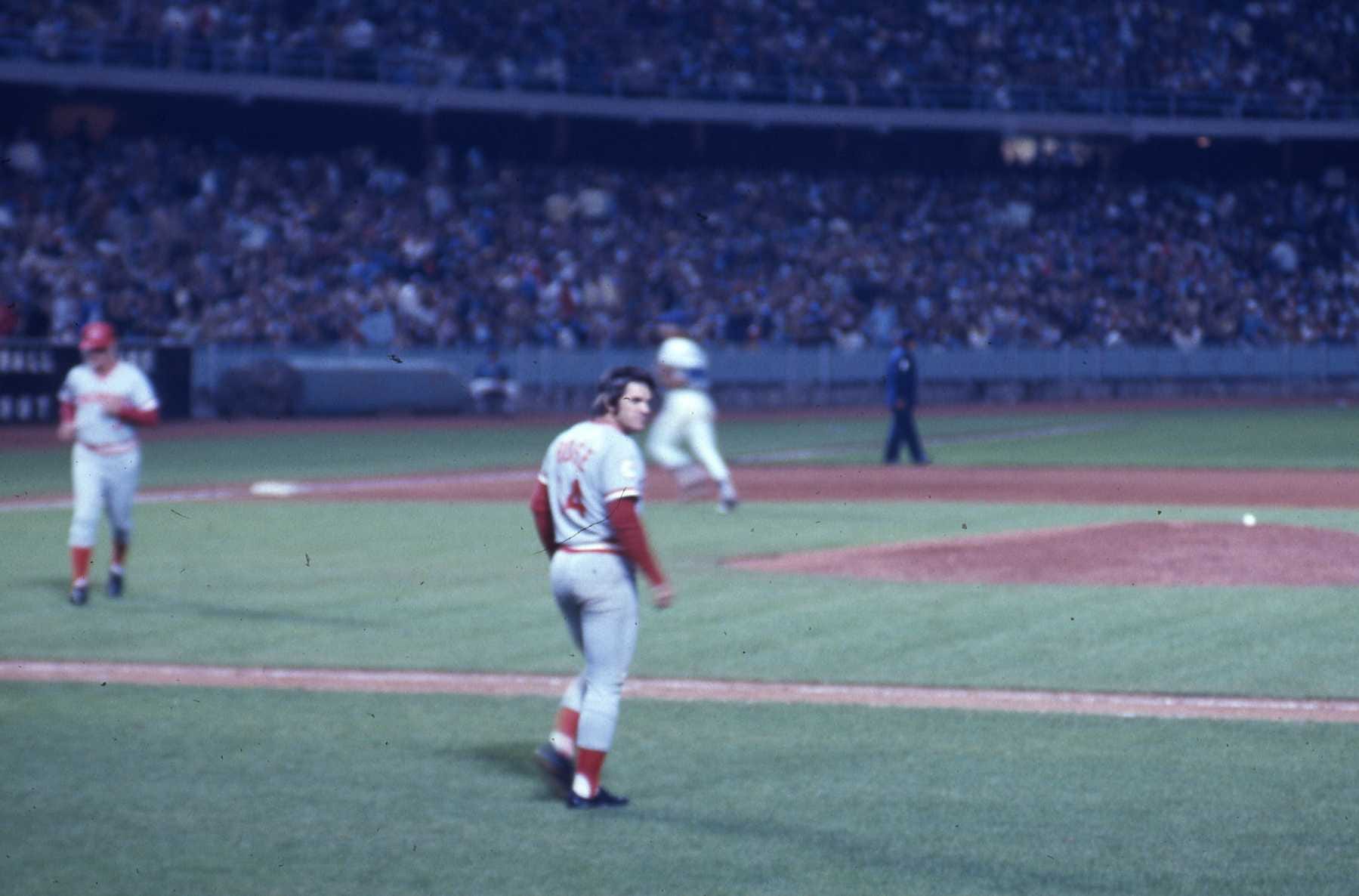
Fueled in this way by White Castle and hatred, our Ahab of the basepaths did not play to make friends. Sprinting to score in the 1970 All-Star Game, Rose football-tackled catcher Ray Fosse as Fosse, ball in hand, sought to block the plate. The tackle, though legal, remains infamous, as the collision injured both players—and the All-Star game is an exhibition, which is to say, it doesn’t count. Though he played on for another nine years, Fosse’s shoulder nagged him for the rest of his life. To pancake Fosse that way, in that game, was, to Rose’s detractors, irrational—even absurd.
The only other player with 4,000 hits retired in 1928. Ty Cobb:
regarded baseball as "something like a war," second baseman Charlie Gehringer said. "Every time at bat for him was a crusade." Baseball historian John Thorn wrote, "He is testament to how far you can get simply through will... Cobb was pursued by demons."


After retiring, while managing the Reds, Rose secretly placed bets on the Reds to win; when this was discovered he was banned from baseball for life. (Gambling, one strains to remember, was an illicit pastime until several months ago.)
Rose also bent—broke—one of the game’s more commonly flouted regulations. He showed Gioiosa a hole in his bat:
“Check it out. Cork,” Gioiosa says Rose told him. Under the rules of Major League Baseball, bats cannot be internally tampered with in any way. Despite the rule, in an effort to give the ball added jump when contact is made, players have for years resorted to secretly inserting cork into bats by drilling a hole and then resealing it. When Gioiosa asked Rose what would happen if it broke, the response was “There’d be fucking cork all over the place.”
We could look at Rose as human, only more so. Conversely, we could see him as a man who “makes a beast of himself to avoid the pain of being human.” To say he was driven by hatred—is hatred too strong a word? “He possessed that divine malice without which I cannot imagine perfection,” said Nietzsche of Heinrich Heine. A monstrous will to win, creative and destructive at once, this force we despise and adore in our politicians, our Michael Jordans, our Steve Jobs—what is it but divine malice? After winning two championships with Cincinnati’s Big Red Machine, Rose left the Reds and played elsewhere for several dismal years in the early 80s, only to come back for the ‘84 season. “It was the triumphant return of the native son, for in Cincinnati Rose might as well have been the president of the United States.”
For life
Gioiosa describes the day Rose broke Ty Cobb’s record:
[Gioiosa] was watching Rose get dressed, and there was something he always found beautiful about it because of Rose’s obsession with perfection and detail, the embodiment of everything he was as a baseball player—the polished shoes, the shirt and socks just so, the bat wiped down with rubbing alcohol so that when he was at the plate and fouled one off he could see exactly where on the bat he had hit it.
But on this particular night, with its history-making implications, there was a departure. Gioiosa watched as Rose put on several undershirts instead of just one. It may have been puzzling at first. But Rose’s explanation said it all.
“I’ll sell every one of these motherfuckers.”
Charlie Hustle has a lust for life. Lust, we’re told, is a deadly sin—which is striking, since lust is ineliminable; deathless, really. The attempt to prohibit lust tells us how much we have in common with the ancient theologians whose humanity we coinhabit. Tells us how much doesn’t change.
“Every heroic act measures itself by its contempt of some external good.” — Emerson
While Hamlin convalesced, this headline appeared: “Damar Hamlin's dreadful collapse: Just another reason to defund football.”
He was wise who said, “Distrust all in whom the impulse to punish is powerful.”
When I still feared for Hamlin’s life, one of the poems I wanted to quote was by the criminally under-anthologized Jack Gilbert. His poem “Falling and Flying” begins:
Everyone forgets that Icarus also flew. / It’s the same when love comes to an end, / or the marriage fails and people say / they knew it was a mistake, that everybody / said it would never work.
Icarus is our ancient symbol of ambition. He and his father built wings to escape the minotaur’s Labyrinth. The wings worked, but Icarus, in the joy of his flight, forgot his father’s warning not to fly too close to the sun. The sun melted his wings and he fell to his death.
Gilbert’s poem closes:
I believe Icarus was not failing as he fell, / but just coming to the end of his triumph.
Icarus comes back, phoenix-like, even when we think we’ve left him for dead. Earlier in the pandemic, women on TikTok shared tales of having “girlbossed too close to the sun.”
It was irrational, even absurd, for Icarus to fly so high. He had already escaped—he and his father.
Ecclesiastes begins: “Vanity of vanities. All is vanity.” But the original Hebrew is open to interpretation. Michael V. Fox’s translation reads, “Absurdity of absurdities. All is absurdity.”
Damar Hamlin flew and fell and was reborn a phoenix. When he regained consciousness in the hospital, his first words were openly heroic: “Did we win?”
Heinrich Heine: “And the miracle bird sings, flying.”
Why did Pete Rose tackle Ray Fosse at the All-Star Game? In 2017, he explained:
I've got to do everything I can to score there. My dad's at the game.
The Bengals game just kicked off; my parents are downstairs watching. I gotta go join them. How badly do I want the Bengals to win?
Absurdly badly.
See you Friday, dear friends.
Bonus epigraphs:
Andrew Dickson White, co-founder of Cornell and its first president, detested football. Declaring the game a “vestige of barbarity,” he denied permission for the Cornell team to play an 1874 game against Michigan. — The Ithaca Times
Saying Yes to life even in its strangest and hardest problems, the will to life rejoicing over its own inexhaustibility even in the very sacrifice of its highest types… in order to be oneself the eternal joy of becoming, beyond all terror and pity—that joy which included even joy in destroying. — Nietzsche