


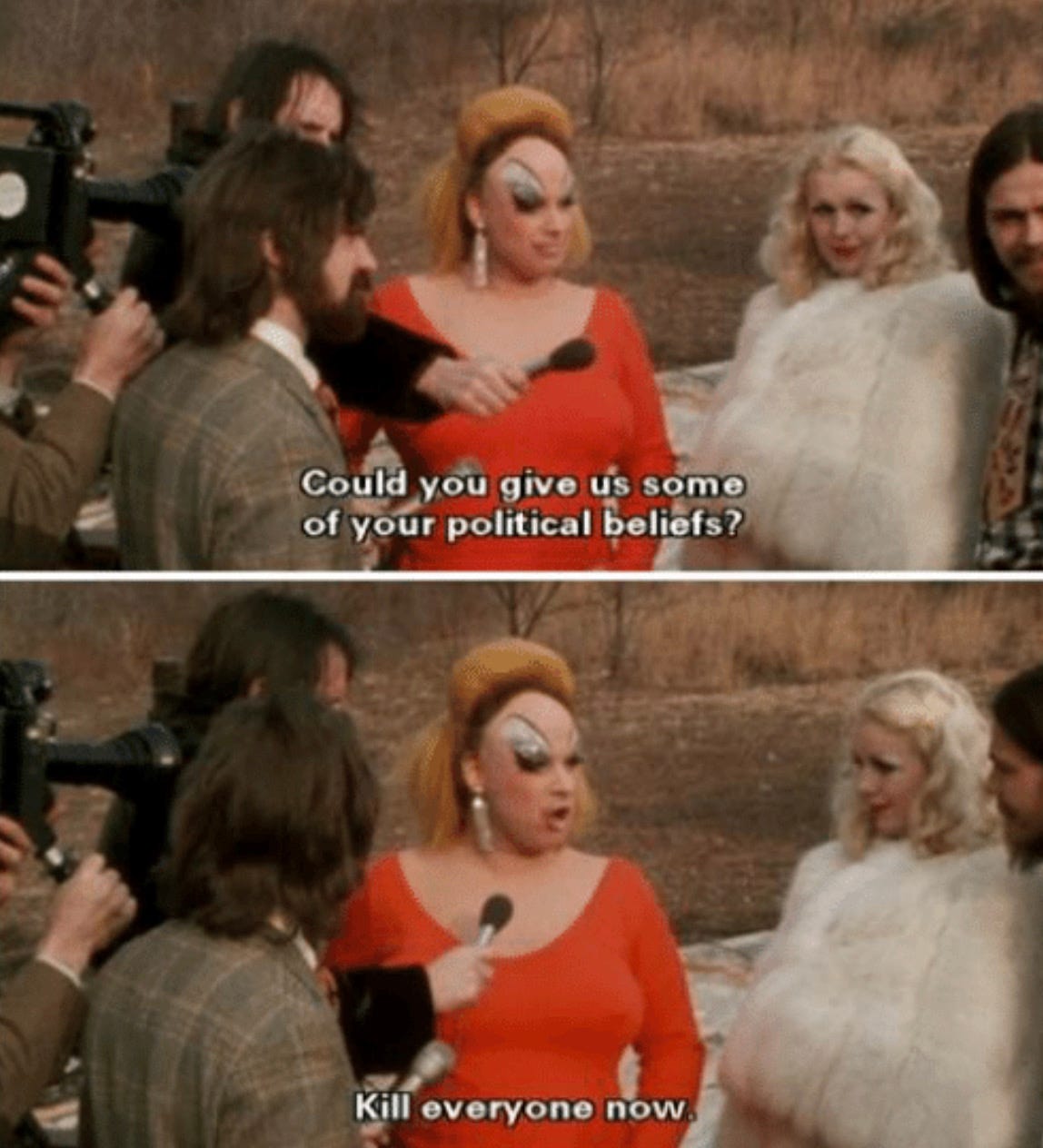
The world is ending. Ask any of the few billion people left alive.
Earlier this year, when I said “I’m not sure the world is actually ending” to a colleague, she did not respond, “It better not. I just bought tickets to Porto for April.”
Instead she seemed surprised and said, “What do you mean?”
I’ve now had versions of this conversation more times than I can count. While writers and grad students can always be counted on for grouchy contrarianism, the phenomenon now appears general. Post-2008 pessimism has curdled, for many, into outright nihilism.
It’s one thing to be skeptical of “progress” in its many guises; what I’ve been more surprised to encounter is an apparently widespread belief that our species has no future, full stop—that the 21st or 22nd century will be our last. Its exponents seem not to notice the distinction, but the positive claim that Humanity Is Doomed is exponentially more difficult to substantiate than mere nihilism. Anyone can tell you that life is absurd and intrinsically meaningless. Only an oracle can tell you when life will end.
Funnily enough, these new prophets of the apocalypse are the same persons who’ve spent their lives ridiculing Christian belief in the Rapture. “But Alex,” you say, “I’m not religious. Religion is irrational. My apocalypse is scientific and/or political.” Indeed. (Note that all three flavors of apocalypse are equally animated by moral fervor—the shared ghost in their logical machinery.)
For end-is-nigh progressives, Christians are ironically correct that humans can predict the future from reading books; they’ve just been reading the wrong books. In the new books, the thinking goes, we’ve worked out all the kinks.
(Shoutout to my Marxist friends now thinking, “How new of a book are we talking? Doesn’t have to be new-new, right?”)
This secular eschatology also appears in weaker forms. One encounters people who believe humans will still exist a century or two from now, but civilization as we know it is on the verge of collapse. Or that the wider world might trundle on serviceably, but America, specifically, is nearly over.
One begins to hear an undercurrent of aspiration in these fantasies of ruin. Freud had a point with the “death drive” stuff!
When I say this I am speaking from experience. Trump, Covid, and meme-friendly climate panic have driven the already anxiety-prone MSNBC crowd into a mental bunker in which “preppers” had the right idea in building literal bunkers, but joining them would be in poor taste.
Mark Fisher Frederic Jameson said “It is easier to imagine the end of the world than the end of capitalism.” The fashionable reply: ¿Por que no los dos?
Having angered ~70% of my small-but-mighty audience, I arrive at my angle.
I now feel strongly that all of the doomers are wrong. If any of them are up for it, I would love to make a friendly wager or two.
Where I need help is coming up with the terms of the bet. What is the victory condition for the endurance of civilization in the medium term? What would quantifiably indicate that we are turning the corner on decarbonization?
My mom would know the world was ending if she ordered something from Talbots on purpose. What about the rest of us?
Human activity has already warmed the planet by 1.2°C. The Paris Agreement seeks to limit total warming to 1.5°. Optimistic projections predict reaching, but not exceeding, that threshold this century. In pessimistic scenarios, the planet warms by 3.0° by 2050 with worse to come; catastrophe reigns.
I’ve been playing with proposals like this:
If total post-industrial warming does not exceed 2.4°C by 2050, and is generally projected to remain flat or reverse, I win the bet, and am super old. (But victorious.)
Inversely, if total post-industrial warming reaches 2.5°C before 2050, I immediately lose the bet and grow old in ignominy, with the possible consolation of tanning in January.
(If, in 2050, warming is below 2.5°C but generally projected to reach it by 2100, I still lose.)
Something like that?
I fear I will struggle to find takers for a bet against human existence; for one thing, such a counterparty would be dubious of surviving long enough to collect their winnings. But it’s fun to try to come up with terms for the bet.
If we reach 2050 and there are still daily commercial flights between New York and London, as well as between San Francisco and Tokyo, I win. If there aren’t, the haters were right; if the economy is also over and they can find me in the ashes, my old ass will work off the debt for them. That kind of thing?
Hearing scared people talk, I almost want to offer terms based on a human population which has been cut in half, say to 3.5 billion people, by 2050—or is projected to do so by 2100—but that is so fantastically unlikely that I fear such a bet would constitute bullying.1 That said, I’m open to negotiation.
America-wise, I need to do more research, but I’m thoroughly unconvinced we’ll be eclipsed by China or India in GDP or whatever in my lifetime.
Final enticement: I’m wrong constantly. This could be a great way to make money as “society” “collapses” “around” you. In 2010 I bet my coworker Steve $500 that Lady Gaga would be a bigger/more acclaimed/more impactful artist than fucking Beyonce by 2020. I know. I WAS REALLY REALLY INTO THE “BAD ROMANCE” VIDEO WHAT CAN I TELL YOU.
This is the email I just sent him:

Like I said, I need your help. Comment below???
SEE YOU NEXT FRIDAY, DEAR FRIENDS.
Some of you are now saying, “To the contrary, Alex: our problem is too many people.” Fun fact: decades’ worth of predictions of disastrous overpopulation have now proved so cartoonishly wrong that a growing number of countries now face or will soon face the opposite problem, with the planet as a whole to follow. Malthus is not doing well, as dead people go.
Sometime we just need hugs and coffee