


Bad week for banks! As far as I know, it wasn’t my fault.
But I gotta admit that my timing could not have been worse in saying that lending money at interest is an easy way to make money; Silicon Valley Bank’s efforts to do so were destroyed by little more than buying the wrong flavor of T-bonds. On the other hand, however esoteric such an error appears to laypersons like me, for bankers, the failure to anticipate that interest rates can go up is analogous to structural engineers failing to anticipate that weather can be windy.
Still with me? No? Excellent. Me neither.
I love my readers. With the ink barely dry on last week’s newsletter, I was happily corrected on two fronts: the D.B. Cooper saga, I’m told, figures as a major subplot in Prison Break, “a surprisingly good show”—and a version of my proposal for a heist–hack of the New York Stock Exchange data center in Mahwah appears in “season 3, episode 20” of Elementary. (!)
As ever, the line between fiction and reality is blurrier than commonly acknowledged. I think about Minority Report a lot. Would today’s college freshmen even notice that movie’s depiction, so futuristic at the time, of ubiquitous video ads in public places? Hell, in Bushwick and Oakland, we even have pods of young women with obstreperous vibes and unusual haircuts who are happy to predict your future; they just prefer to be called witches rather than precogs.
Not spooky enough? Kk.
Months before the now-infamous train derailment in East Palestine, Ohio, the town served as the filming location for the Netflix adaptation of a 1985 Don DeLillo novel about… an ominous cloud of gas released by a train derailment in a small town, the government’s slow-footed response, and the revealed strangeness of normal life—of fluorescent-lit grocery stores—amidst a media circus as the toxic event belatedly, for lack of a worse word, goes viral.
It feels impossible and it’s true.
In DeLillo’s novel, no one wants to acknowledge the danger ‘til it’s too late; by the time safety returns, everyone is obsessed with preparedness—for a threat that is no longer threatening. Months later, the protagonist panics to discover his daughter lying motionless in the street; when he asks if she’s okay, she shoos him away—he’s interrupting the toxic-event simulation drill in which she’s enthusiastically playing the role of a casualty. Others play dead nearby. Men in freaky biohazard suits approach, tragicomic with seriousness—eager, like daters without therapy, to deliver everything that was missing in the past, when it mattered.
As the brilliant Adam Mastroianni wrote recently in Experimental History , we don’t learn things by learning things. We learn things by sprinting into brick walls. Only then do we remember the warnings we’d ignored.
Doing nothing remains permanently if deceptively unappealing; ours is a restless race. Better to test new flavors of heedlessness, like sprinting into the wall and concluding that we weren’t running fast enough. And somehow, “Things do get done in this way, but never the things we set out to accomplish.” The instinct to overcorrect appears unavoidable, yet the resulting game of whack-a-mole that is life in a democracy remains, as Churchill said, the worst possible system except for all the others.
Infomercials for the future
Mastroianni is only usually right, thank Christ. I take immense solace every time someone (anyone) learns something (anything) without the benefit of catastrophe. These lessons, ironically, are all the more forgettable.
Hole in the ozone? Patched. The rivers of America’s cities? Weirdly safe to swim in. Dolphins visit the East River, now. We fucking did it, guys.
During the Cold War, the nuclear arms race appeared likely to kill hundreds of millions of people, if not extinguish humanity entirely. After near-misses of which the Cuban Missile Crisis is only the least secret example, a mass movement arose, now largely forgotten, demanding nuclear disarmament. A million singing people filled Central Park. The guy who adopts Babe the pig in Babe and Babe 2: Pig in the City—the “That’ll do, pig” guy—was arrested dozens of times for chaining himself to nuclear-weapon factories.
And it all might have been for nothing if it weren’t for WarGames.
At the risk of sounding like Nicole Kidman’s motionless face, stories, even fictions, are uniquely capable of making warnings legible.
The religion I was raised in holds that, since Ronald Reagan died in his sleep, God must not exist or is a sadist. Like all children, I had to find a way to rebel without entirely alienating the hands that feed, especially if I wanted to be a poet. So while I’m hardly a Reaganite, credit where credit is due.
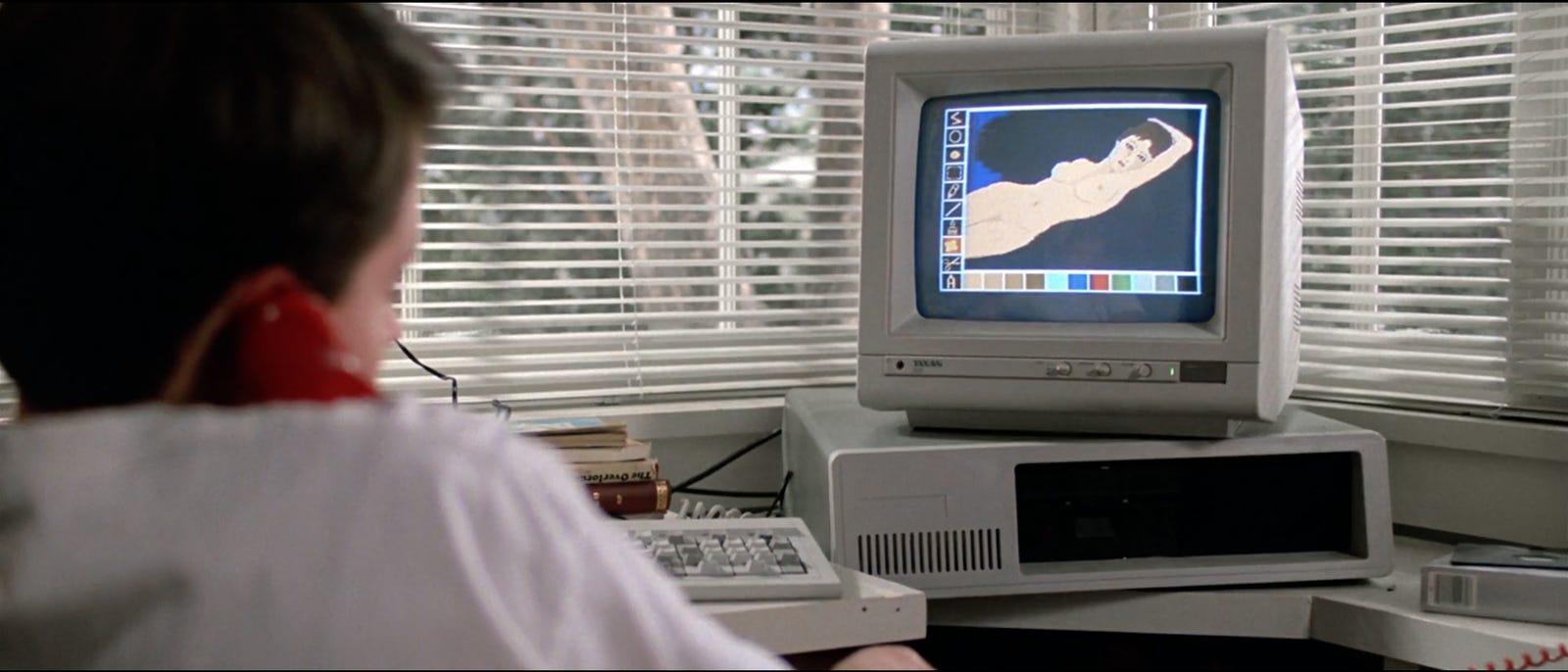
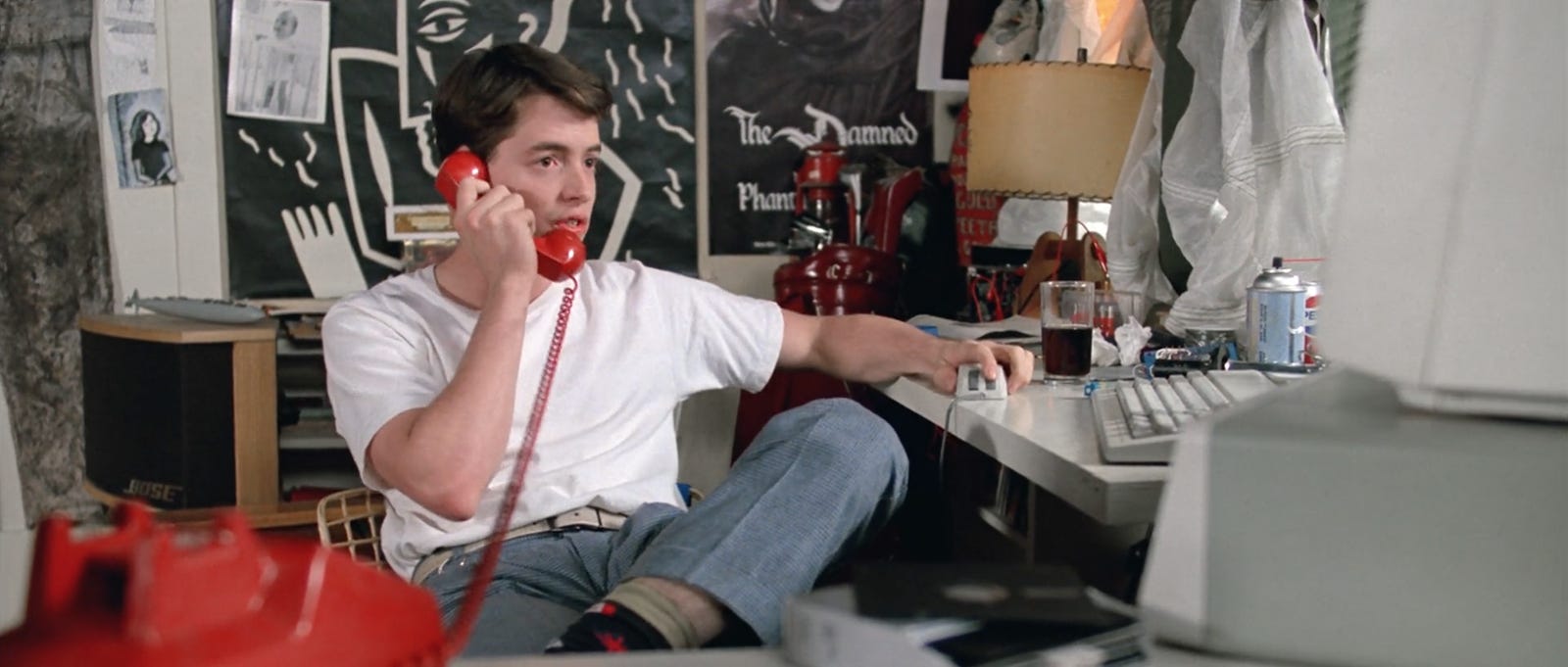
In 1983, two movies changed the course of history. Both WarGames1 and The Day After2 horrified President Reagan. In WarGames, Ferris Bueller hacks the wrong mainframe, accidentally unleashing a rogue artificial intelligence bent on nuclear apocalypse. In The Day After, that apocalypse arrives; the main characters, middle-class normies in Lawrence, Kansas, die quickly from bombing and slowly from fallout.
Inspired to embrace disarmament, Reagan met Gorbachev in Reykjavik, where the two leaders agreed to slash their nations’ stockpiles of nuclear weapons.3 In 1985, there were more than 60,000 nukes; today, fewer than 13,000 remain—an 80% reduction to the gravest threat in history. While the optimal number of nukes is obviously zero, the fact is that our species was sprinting toward a brick wall of annihilation—classic human guilty pleasure—and decided to stop. With one annihilation at bay, we’ve stayed alive long enough to find new flavors of apocalypse to fret about.
Life moves pretty fast—you don’t stop and look around once in a while, you could miss it
We started an apocalypse and nobody came. My pet theory about Christopher Nolan is that his time-travel movie Tenet was a noble if illegible effort to dramatize arms-control counterfactuals—to inspire us to notice the heroes whose glories are explosions that never happened. The legacy of Reykjavik was self-erasing; reversing the arms race meant we could stop panicking, return to normal life, and temporarily forget the strangeness of fluorescent-lit grocery stores.
Not-funnily enough, just as we’ve started to turn the corner on climate change, Russia canceled our last major arms-control treaty, resurrecting the specter of mushroom clouds. I’m hopeful that nuclear weapons’ return to the real-life spotlight—Don’t call it a comeback / Been here for years—motivates us to dismantle more of them. Bombs are bad for the environment, if that helps.
In Ferris Bueller’s Day Off, the slogan “Save Ferris” goes viral in Chicago; banners blossom at Wrigley and beyond. The joke is that Ferris never needed saving, and the punchline is that he saved the world.
See you this weekend, dear friends.
Ronald Reagan, a former Hollywood star, screened WarGames at Camp David the weekend it was released, and it freaked him out… Reagan brought it up a few days later at a White House meeting that included the chairman of the Joint Chiefs of Staff and asked, “Could something like this really happen? Could someone break into our most sensitive computers?” The answer came back a week later: “Mr. President, the problem is much worse than you think.” That led not only to a significant revamp of how computer security was handled at the Defense Department, but also passage of an anti-hacking law that would eventually evolve into our current Computer Fraud and Abuse Act. Clips of WarGames were shown during the congressional hearings where lawmakers debated the need for hacking legislation.
— Kevin Bankston for New America; also quotes Fred Kaplan
[The Day After] was also a turning point for foreign policy. Thirty-five years ago, the United States and the Soviet Union were in a nuclear arms race that had taken them to the brink of war. The Day After was a piercing wakeup shriek, not just for the general public but also for then-President Ronald Reagan. Shortly after he saw the film, Reagan gave a speech saying that he, too, had a dream: that nuclear weapons would be “banished from the face of the Earth.” A few years later, Reagan and Soviet leader Mikhail Gorbachev signed the Intermediate-Range Nuclear Forces (INF) Treaty, the first agreement that provided for the elimination of an entire category of nuclear weapons. By the late 1990s, American and Russian leaders had created a stable, treaty-based arms-control infrastructure and expected it to continue improving over time.
— Dawn Stover, Bulletin of the Atomic Scientists
In his dealing with the Soviets, Reagan’s two terms were almost those of two different presidents. Both the hard-liner and the peacemaker were present throughout, but the balance shifted so decisively from one to the other as to create a discontinuity. The man who had denounced the nuclear freeze as Soviet propaganda was now suggesting not just reduction but elimination of all nuclear weapons.
What explains Reagan’s remarkable transformation from Cold War hawk to nuclear peacemaker? His nuclear abolitionism had deep roots, going back to a flirtation with pacifism in the early 1930s. His antiwar side was connected to narratives and images that deeply affected him: seeing the British antiwar play Journey’s End in 1929, being shown footage from the liberation of Auschwitz in 1945, and watching the ABC television movie The Day After in 1983. A projection that stuck with him was that at least 150 million Americans—two-thirds of the population in 1980—would be killed in an all-out nuclear war, though he believed for some reason that Soviet losses would be limited to a much smaller percentage. Advisers who “tossed around macabre jargon about ‘throw weights’ and ‘kill ratios’ as if they were talking about baseball scores” appalled him. In his diary and to aides, Reagan even worried that the biblical prophecy of Armageddon was at hand.
— Jacob Weisberg, The Atlantic