


Did you guys see that thing in the news?
No, not that thing. Oof, though.
Or that one. Dude, horrible.
Not the articles about suffering and its ineradicable nature. Not the reiteration of frailty. Not despair and not terror and not rage.
Not, Christ Jesus, Twitter.
(Have you noticed how quickly the term “doomscrolling,” which originally described a subcategory of online experience—the queasily addictive consumption of bad news—became synonymous with social media as a whole?)
No. I’m talking about the other thing.
Last week, the Times published an article called “Beyond Catastrophe.” Emphasis mine:
Thanks to astonishing declines in the price of renewables, a truly global political mobilization, a clearer picture of the energy future and serious policy focus from world leaders, we have cut expected warming almost in half in just five years.
[reads the sentence again]
Wait, what?
Globally, there are enough solar-panel factories being built to produce the necessary energy to limit warming to below two degrees, and in the United States, planned solar farms now exceed today’s total worldwide operating capacity.
Okay, wow??
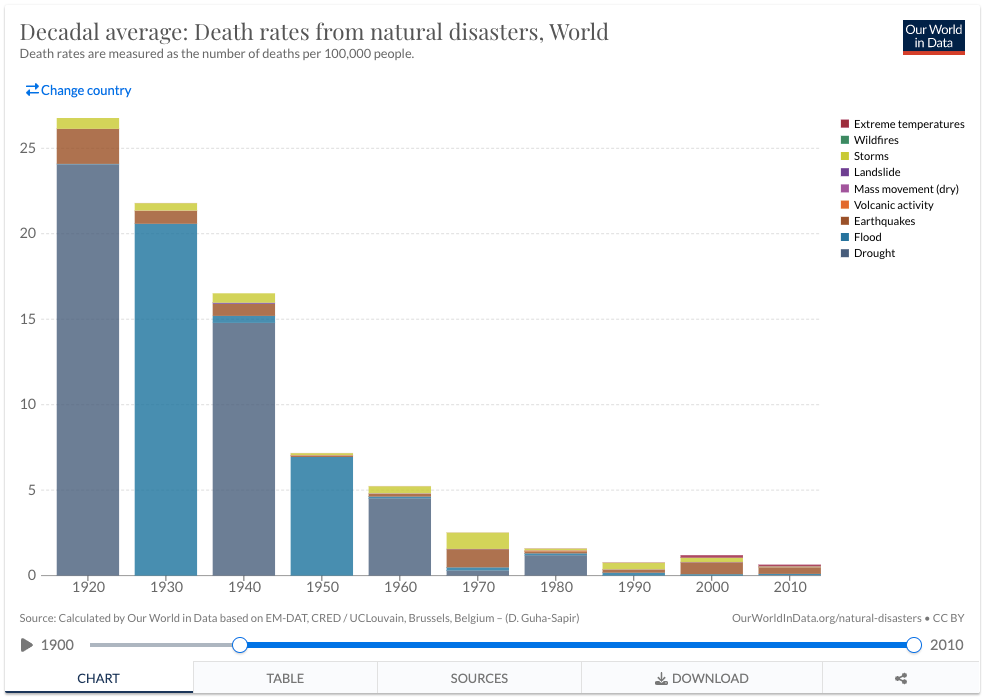
Even as we put ourselves in the path of extreme weather, deaths from natural disasters are not, in fact, growing—indeed, they have fallen, by an astonishing degree, from as much as an average of 500,000 deaths each year a century ago to about 50,000 deaths each year today (even as climate- and weather-related natural disasters have increased fivefold, according to the World Meteorological Organization).
And over that same period, the global population has more than tripled, which means rates of disaster death have fallen even more dramatically per capita:
Well, that’s a relief!
…
Isn’t it?
Such optimism! Wonderful to read, although not grounded on anything resembling reality.
So begins the most popular comment posted in response to the article. The readers of the New York Times will not be fooled so easily:
Talk about Pollyanna, I don't know what you are reading that gives you such unfounded optimism.
Outrage, yes. But pity, also. From the carefully named “Naivesosad”:
My initial reaction is "How rosy and naive."
Meanwhile, “NJThoughts” pulls no punches:
This article tries to put a positive spin on what is an increasingly horrific situation, and to my mind it reeks of desperation.
The most popular comments are virtually unanimous. They “reject” the article’s “un-scientific and dangerously optimistic view.” Readers can see the writing on the wall. Here on Earth, “We are barreling toward catastrophe.”
Plainly, “There is no good news.” And that’s not even the bad news.
For our kids' sake, we can never give up the fight. We must change in order to survive.
What gives? What kind of asshole wrote that “extremely dangerous article”? Dick Cheney? Greg Exxon? Perhaps Hexxus, the villainous “blob of crawling petrol” from Fern Gully?
None of the above. It was written by David Wallace-Wells, author of #1 bestseller The Uninhabitable Earth, a vividly gruesome exploration of global warming’s worst-case scenarios published in 2019. He adapted the book from his 2017 essay, also named “The Uninhabitable Earth,” after it became the most-read article in the history of New York magazine.
In other words: Wallace-Wells is probably the single person most responsible for the popularization of the view that climate change will kill every man, woman, and child.
The commenters on his latest article might not recognize his name, but they’ve been drinking his Kool-Aid.
Imagine their discomfort encountering an insufficiently cataclysmic climate bulletin—in the Times, no less. What is this clown talking about with his nonsense that we’re going to survive? Hasn’t he read David Wallace-Wells?1
In the five years since publishing “Uninhabitable Earth,” Wallace-Wells avidly followed developments in science, technology, and politics. As he wrote last week:
For me, the last few years provide arguments for both buoyant optimism and abject despair. They have made me more mindful of the inescapable challenge of uncertainty when it comes to projecting the future.
Sure. Ambiguity and all that.
Meanwhile, progressives had fallen in love with his apocalypse. Myself included. “Abject despair”? We’re freaks for that shit. We don’t want to hear the new acoustic album with your measured reflections, bro. Play your old stuff. Hurt me.
So—was he right that the sky is falling, or not? Which Wallace-Wells can I trust?
Experts reading his 2017 essay reached a consensus of their own:
Seventeen scientists analyzed the article and estimated its overall scientific credibility to be “low.” A majority of reviewers tagged the article as: Alarmist, Imprecise/Unclear, Misleading.
Everyone’s a critic!!!!!!!
David Wallace-Wells is the boy who cried wolf—in reverse.
The boy who cried wolf foolishly raised alarm until no one believed in the threat. Vigilance was abandoned. When conditions changed, people’s feelings didn’t.
Wallace-Wells persuasively raised alarm until everyone believed in the threat. Vigilance was adopted. When conditions changed, people’s feelings didn’t.
How did “Don’t shoot the messenger” become an expression, even? Must be a dicey business, being the messenger.
As recently as last week, headline writers at the Times were feeling very 2017: “Brazil's Presidential Election Will Determine the Planet's Future.”
Glad to be off the hook for that personally, at least.
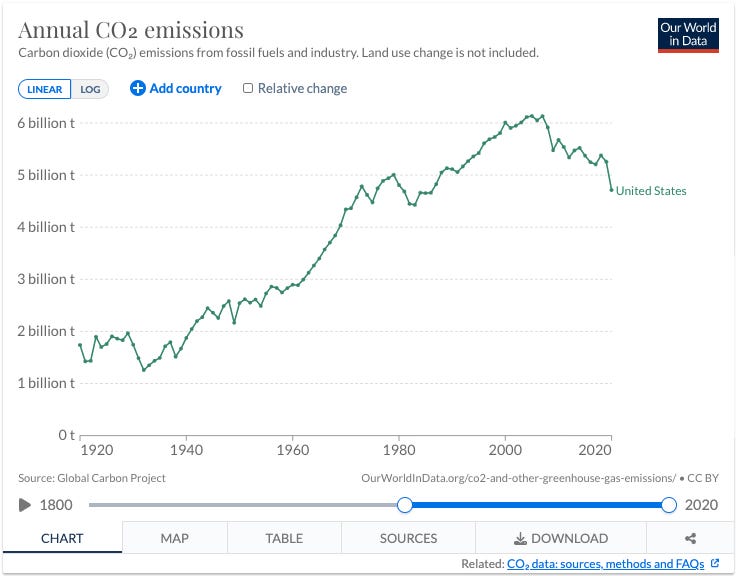
Fun quiz for cocktail parties: Did American carbon emissions increase more under Trump or under Obama?
Trick question. They’ve been decreasing since 2007, before Bush left office. I guess the Twin Towers aren’t the only things he knocked down
I don’t share this to say, “Climate change is fake and/or over.” It isn’t and isn’t.
If my friends and readers were Republicans, I would have approached this material differently. As it is, I know we need every excuse to relax we can get.
To borrow the finale of “Beyond Catastrophe”:
“We’ve come a long way, and we’ve still got a long way to go,” says Hayhoe, the Canadian scientist, comparing the world’s progress to a long hike. “We’re halfway there. Look at the great view behind you. We actually made it up halfway, and it was a hard slog. So take a breather, pat yourself on the back, but then look up—that’s where we have to go. So let’s keep on going.”
SEE YOU NEXT FRIDAY, DEAR FRIENDS.
In Annie Hall, a boor’s monologue about the philosophy of Marshall McLuhan is unexpectedly interrupted—by the actual Marshall McLuhan: “You know nothing of my work.” In the case of Wallace-Wells’ 2022 article, the commenters say, in effect: “You know nothing of your work.”