


Nobody should experience anything they don’t need to, if they don’t need poetry bully for them. I like the movies too. — Frank O’Hara
A thing about writing is the way it unfolds in time—with surprises, as we say, in store, for the reader and the writer both. By the end of the paragraph, you know something about the writer that he doesn’t know about himself. He will beg, beg is the word for it, you to tell him this thing you’ve learned. You are welcome to try, but the secret has a secret, which is that it belongs to you alone, is music for you and white noise for him, the way cilantro tastes soapy for certain persons, or the way, in the weeks before I was born, Geraldo prepared a two-hour special in which he would unseal, live on TV, Al Capone’s underground vault, which had been sealed for half a century. What would the vault contain? When, live on TV, Geraldo unsealed it, he and America discovered simultaneously that the vault was empty except for Geraldo himself. Geraldo thought, “I’ve learned nothing about crime, I should stay inside the vault.” America thought, “I’ve learned a lot about Geraldo, I should stay on this channel.” Nothing, for poets, was the second-best thing the vault could have contained. What did your mind unseal, just now, as first-best? For me, the best-best thing would’ve been a written explanation of why this paragraph begins with the phrase “A thing about writing is.”
Writing a poem is like stripping naked while blindfolded. The blindfold is important.
Like a snow-globe, a book pleases the hand as much as the eye: we feel larger than life. Time is our toy, briefly.
For the poet, synecdoche is everything. For the pantheist, everything is synecdoche. Relations between the camps are not unfriendly; historically, two jokes and a snack have been sufficient to convince them that bygones are bygones. Poets and pantheists have a lot in common, is what I’m saying. God forbid they’re ever audited; mention the word “budget,” much less “taxes,” and they scowl in terror like a vampire on a walk of shame. Also avoid, for best results, the words “spreadsheet,” “schedule,” and “plan” with this population. (“Time” is iffy; you’ll make a new friend, but this new friend is Into Crying.)
Geraldo’s vault special “was greatly hyped as potentially revealing great riches or dead bodies on live television. This included the presence of a medical examiner should bodies be found, and agents from the Internal Revenue Service to collect any of Capone's money that might be discovered.”
Like sports or quilting, poetry sublimates will-to-power for the gruesomely ambitious. This is its chief pro-social function.
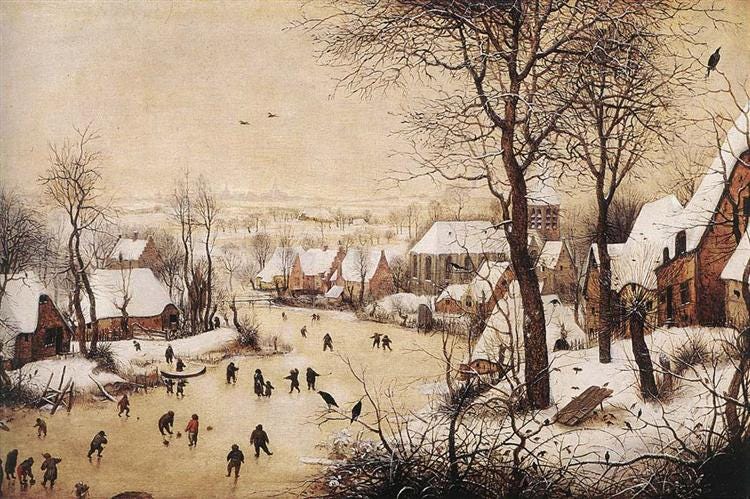
For Plato, we are deceived by appearances, tricked by the shadow-play of “present waking life” into mistaking Becoming for Being. To which Nietzsche says, Hey, is it Opposite Day in Athens? Because that’s exactly backwards. Nietzsche believed his predecessors wasted their lives chasing the mirage of changelessness: they pinned butterflies to walls and called it nature; only Heraclitus, observing that you can’t step in the same river twice, glimpsed that change—say, flow—is all. In a snow-globe or a poem, change appears suspended, and “time is an emulsion.” Outside, meanwhile, in real life, is it raining or is it snowing? “There came a moment that you couldn’t tell / Then they clearly flew instead of fell.” The river freezes over and poets put on ice-skates.
Frank O’Hara said:
I don’t even like rhythm, assonance, all that stuff. You just go on your nerve. If someone’s chasing you down the street with a knife you just run, you don’t turn around and shout, "Give it up! I was a track star for Mineola Prep."
Showing up for practice, however, is another matter. I’m here for track practice.
Capitalist and Marxist agree: bread alone explains the world. The poet, half listening, interrupts to name his favorite breads.
Poets are funny in the wrong way when they endeavor to legislate the relationship between poetry and politics. Poetry is always everything: no son of man nor woman’s daughter has lived on earth who could change that—and Stalin tried!
The higher nature of the universe is knowable to mortal man: on this, atheist and Christian agree. The poet, having heard at a party that men can no more grasp God than dogs can grasp calculus, instead says I’m your dog, and wags.
Dolphins are descended from the creatures who crawled onto land when land was the big new thing—and decided they liked the water better. Poets are to prose as dolphins are to land.
Jodi Foster, in Contact, came face to face with the higher nature of the universe. She said, “They should have sent a poet.”
SEE YOU NEXT FRIDAY, DEAR FRIENDS.
Nothing wrong with being Into Crying. I'm an everything-all-at-once full send brother sort. Like a lifetime original movie if I can cry and laugh about time at the same time while on a shoestring budget it's a win in my book.
Also, you present a very chicken and egg dilemma for dolphins regarding their landing at Plymouth rock.